


Products
Piston Rings
NPR-RIKEN keeps moving forward, striving for the ultimate piston rings!
With our piston rings, we contribute to carbon neutrality around the world!
Piston rings are critical components that directly affect engine performance, including fuel efficiency. In addition, they operate for long periods under the harsh conditions inside an engine. Furthermore, piston rings must be durable enough to maintain their core functions — gas leak prevention, engine oil control, and management of combustion heat.
To meet these demands, we are constantly striving to develop the latest materials and surface coating technologies, as well as micron-level machining techniques. In recent years, as part of our efforts to pursue carbon neutrality, we have been developing technologies to accommodate various fuels, such as hydrogen.
Piston Rings
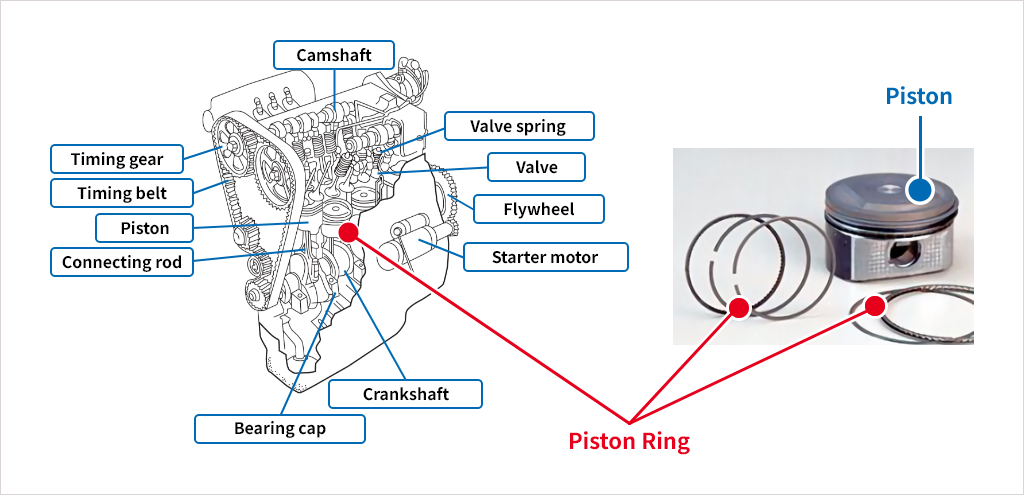
What kind of product is a piston ring?
Piston rings are components assembled into the piston, which receives the combustion force inside the engine.
・The main functions of piston ring are gas sealing, oil consumption control, and heat transfer.
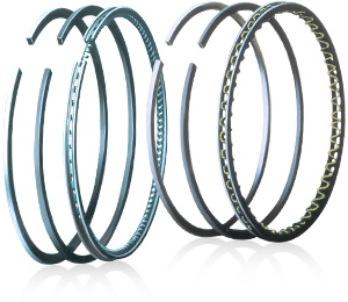
・Generally, three piston rings are installed on each piston.
・Piston rings are springs; when compressed and inserted into the cylinder, they exert a pushing force against the cylinder.
・Piston rings are used in engines for motorcycles, passenger cars, trucks, buses, construction/agricultural machines, generators and so on.
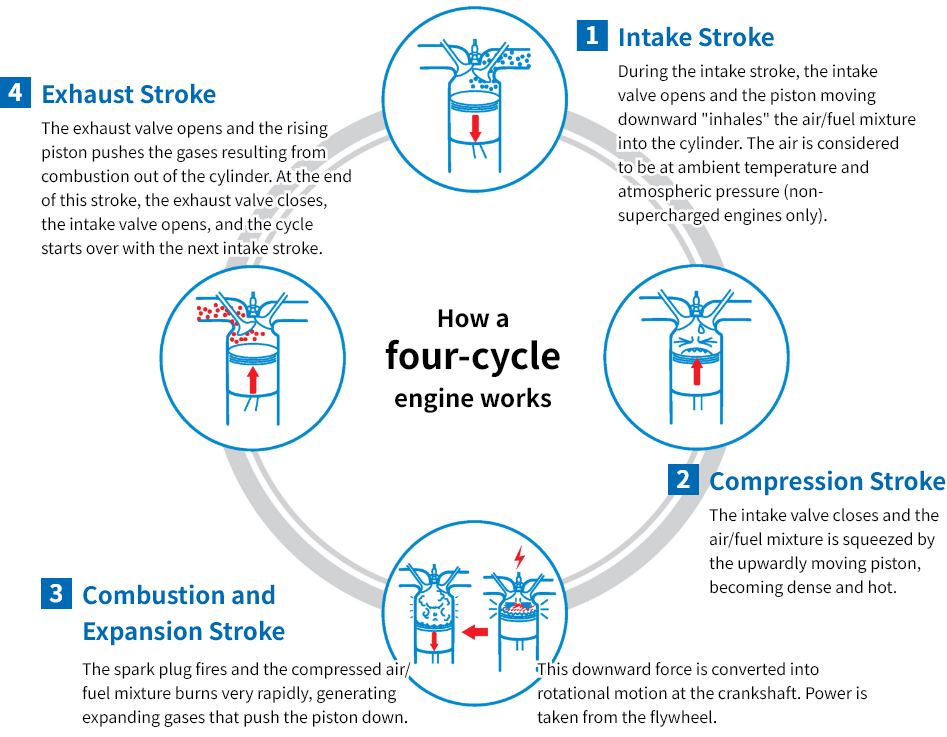
What do piston rings do?
・Piston rings ensure airtightness by contacting the cylinder wall while the piston moves up and down.
・Piston rings prevent the leakage of air, fuel, and combustion gases during the compression and expansion strokes.
・Piston rings suitably control the consumption of engine oil that protects various components.
・Piston rings transfer the heat caused by combustion gases from the piston to the cylinder wall.
The functions of piston rings contribute to reducing exhaust emissions and improving fuel efficiency.
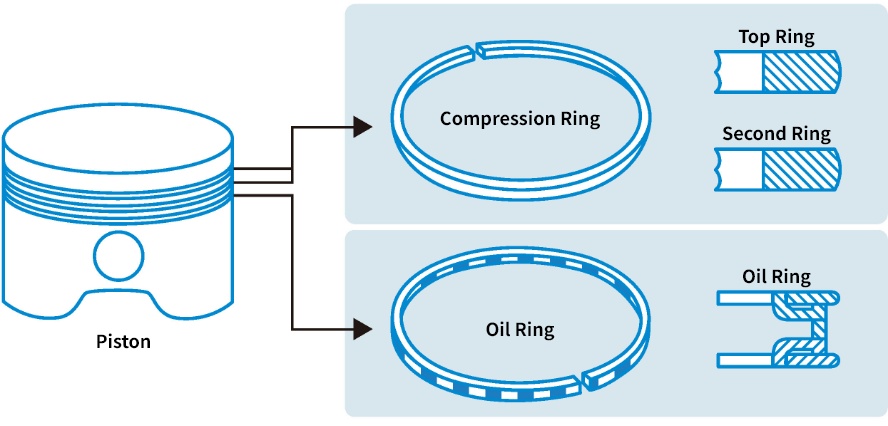
What function does each of the three piston rings perform?
・The TOP ring primarily ensures gas sealing and heat transfer.
・The second ring assists the top ring and the oil control ring in their functions.
・The oil ring regulates the amount of oil between the cylinder and the piston ring.
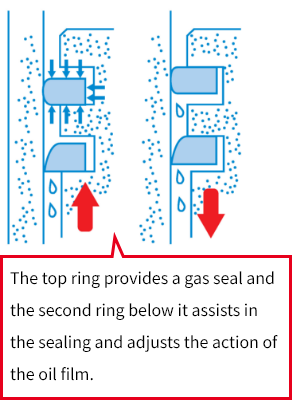
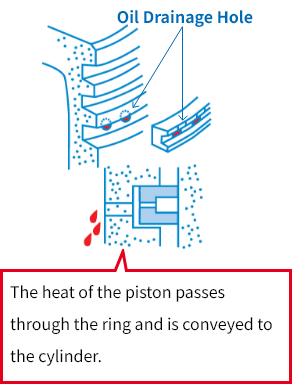
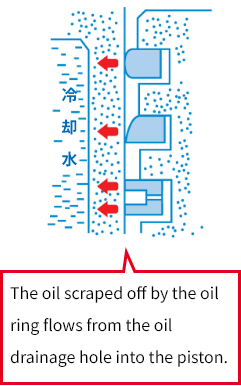
Cited from "エンジンはこうなっている/ This Is How Engines Work" (Grand Prix BOOK PUBLISHING CO.LTD.,)
In what kind of environment do piston rings operate?
・In diesel engines, the piston rings are exposed to combustion pressures of 25 MPa, which is equivalent to the force exerted at a depth of 2,500 meters under water.
・The piston moves back and forth at high speed, as if it were jumping side to side at an average speed of 70 km/h.
・In particular, the top ring operates in an environment with temperatures approaching 300℃.
*While conditions vary depending on the engine and how it is used, the rings operate in the harsh environment of an engine’s interior.
What technologies are applied in the piston rings?
・In the past, cast iron and chrome plating piston ring designs were common, but today, specifications featuring steel with PVD (Physical Vapor Deposition) or DLC (Diamond-Like Carbon) coatings are the standard.
・Surface treatment is a crucial technology and both PVD and DLC ensure durability and reliability with thick layer that are not found in other industries.
・The outer surface that comes into contact with the cylinder wall is machined to a curve (or barrel shape) using micron-level precision technology.
Piston rings for gasoline engine
Position |
Configuration |
Material |
Surface treatment |
|---|---|---|---|
Top |
|
・Steel |
・Chromium Plating ・PVD and DLC |
2nd |
 |
・Cast Iron ・Steel |
・Phosphate Coating ・Chromium Plating and PVD |
Oil |
 |
・Steel |
・PVD and DLC ・Chromium Plating |
Piston rings for diesel engine
Position |
Configuration |
Material |
Surface treatment |
|---|---|---|---|
Top |
 |
・Steel |
・PVD and DLC ・Gas Nitriding |
2nd |
 |
・Cast Iron ・Steel |
・Chromium Plating |
Oil |
 |
・Steel |
・Chromium Plating ・PVD and DLC |
NPR-RIKEN’s piston rings
RIKEN CORPORATION and Nippon Piston Ring Co., Ltd., both are pioneers in the piston ring industry, have merged to establish NPR-RIKEN CORPORATION. Our piston rings represent a fusion of the two companies’ traditions, expertise, and cutting-edge technology. We are confident that our piston rings will meet the expectations of our customers.
Although the shift towards electric vehicles (EVs) is progressing, there remains a significant role for engines as the development towards carbon neutrality continues. We are committed to advancing piston ring development as a united team to contribute to the future of a carbon-neutral society.
We are currently working on the development of hydrogen engines. By converting conventional diesel engines into hydrogen engines, we aim to make existing trucks and buses hydrogen-powered and create a more sustainable society where hydrogen is readily accessible.4
Surface Treatment Technologies
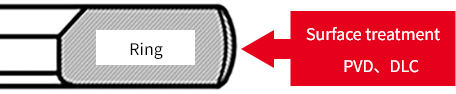
The piston ring's outer surface maintains constant contact with the cylinder wall as it slides along it. For this reason, the outer coating of piston rings must provide high wear resistance, scuff resistance, and low friction. While chrome plating and nitriding were the methods of choice in the past, PVD and DLC coatings, which are harder and offer lower friction resistance, are now commonly used.
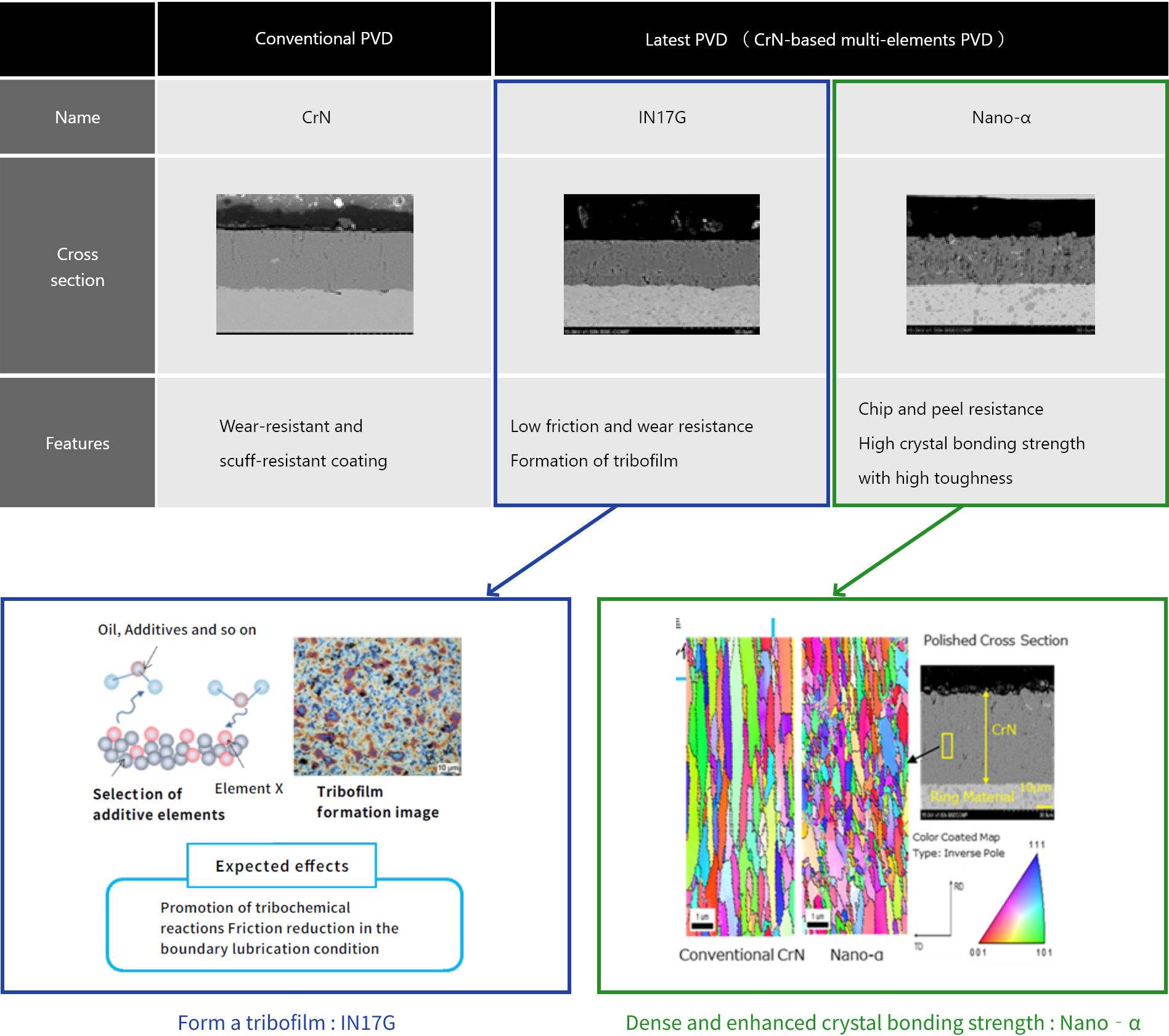
■PVD(Physical Vapor Deposition)
Conventional PVD:Cr-N
Improved wear resistance and friction: IN17G
Improved chip and peel resistance: Nano-α
■DLC(Diamond Like Carbon)
DLC coatings are high-performance coatings characterized by high hardness, excellent wear resistance, and low friction. Because they offer superior wear resistance compared to conventional surface treatment coatings, they provide excellent dimensional stability and maintain their low-friction performance over extended periods. We offer a wide range of hydrogen-free DLC coatings suitable for various environments.
Hydrogen free DLC |
||
|---|---|---|
Coating thickness |
0.8μm | 20μm |
Cross section |
 |
 |
The thickness of the coating can be adjusted to suit the intended application
Overview of Evaluation and Simulation Analysis Technologies
Piston rings operate under extremely harsh conditions. For this reason, evaluation using actual engines is crucial and has been a standard practice for many years. Recently, in an effort to improve development efficiency, we have been utilizing various rig tests and simulations that simulate engine operating conditions. Simulation has become particularly important in recent years. Based on the engine evaluation results, internal engine visualization, and behavioral analysis data we have acquired over the years, we have developed our proprietary simulation technology and are utilizing it for piston ring design and phenomenon analysis.


